Al Schmitt: 23-Time Grammy Winner's Recording Techniques from Sam Cooke to McCartney
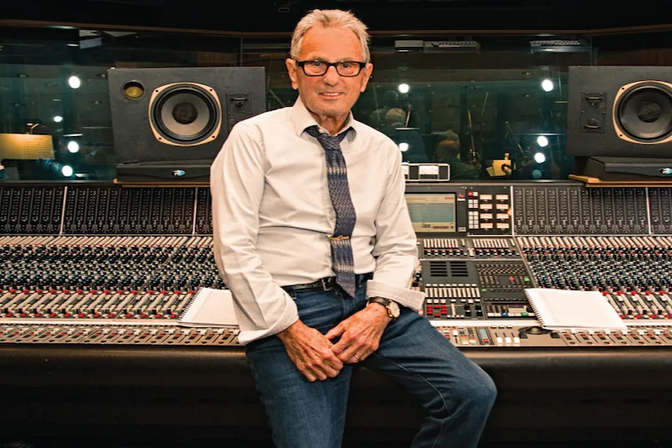
Al Schmitt won more Grammy Awards than any other engineer or mixer in history — 23 total, earned across seven decades of recording. When he died in April 2021 at 91, he’d been behind the board for Sam Cooke in the 1950s and Paul McCartney in 2012, and basically everyone in between.
Born in Brooklyn in 1930, Schmitt started as an apprentice at Apex Recording Studios at 19. That early apprenticeship shaped everything that followed, particularly his conviction about getting the sound right at the source rather than fixing it later.
Core equipment
Schmitt’s studio choices matched his philosophy of minimal processing and natural sound.
Console: He preferred the Neve 8068, an analog console known for its warmth. Even after digital became standard, he’d sum his mixes through the Neve because he felt it added depth.
Monitors: ATC SCM150ASL Pro speakers for their accuracy. He mixed at moderate volumes to avoid ear fatigue and keep perspective.
Microphones: The Neumann U47 was his go-to for vocals. He also used the AKG C12 and Telefunken ELA M 251 for their detailed sound.
Outboard gear:
- Teletronix LA-2A Compressor (his standard vocal compressor)
- Pultec EQP-1A3 Equalizer
- Fairchild 660 Compressor
- EMT 140 Plate Reverb
- API 550A EQ (for its musical quality)
- Tube-Tech CL 1B Compressor
Discography and landmark sessions
Schmitt worked across seven decades and dozens of genres. The list below covers the sessions that defined his reputation, with Grammy wins noted where applicable. If you’re studying how the same minimal-processing approach holds up across styles, this is a useful cross-section to listen through.
1950s–1970s
- Sam Cooke — early RCA sessions (1959–1963). Schmitt recorded Cooke at RCA Hollywood, capturing his voice with minimal processing. This is where his “get it right at the source” instinct hardened into a working method.
- Jefferson Airplane — Surrealistic Pillow (1967). One of his first major rock sessions, showing the approach worked outside jazz and R&B.
- George Benson — Breezin’ (1976) ⭐ Grammy: Record of the Year (“This Masquerade”). The session that made him a household name in major-label engineering circles.
- Steely Dan — _Aja_ (1977) ⭐ Grammy: Best Engineered Album, Non-Classical. Often cited as a reference recording for how to place instruments in a mix. The drum sound on this record is still studied.
1980s–2000s
- Toto — Toto IV (1982) ⭐ Grammy: Best Engineered Album, Non-Classical. Four Grammys total for the album, including Record of the Year for “Rosanna.”
- Natalie Cole — Unforgettable… with Love (1991) ⭐ Grammy: Album of the Year, Record of the Year. A technically demanding project—Cole’s voice was recorded separately and blended with archival Nat King Cole recordings.
- Frank Sinatra — _Duets* (1993) ⭐ Grammy: Best Traditional Pop Vocal Performance. Schmitt engineered and mixed the final album.
- Diana Krall — _When I Look in Your Eyes* (1999) ⭐ Grammy: Best Jazz Vocal Performance. Recorded live to two-track with minimal overdubs.
- Ray Charles — Genius Loves Company (2004) ⭐ Grammy: Album of the Year, Best Engineered Album. Recorded partly during Charles’ final sessions before his death in June 2004.
- Michael Bublé — Call Me Irresponsible (2007) ⭐ Grammy: Best Traditional Pop Vocal Album.
2010s
- Paul McCartney — Kisses on the Bottom (2012). Standards album tracked at Capitol Studios in Hollywood, where Schmitt had spent much of his career.
Mixing philosophy
Schmitt’s approach: capture great performances with great microphone placement, then stay out of the way.
“If you get it right at the source, you don’t have to do much after that,” he said. This wasn’t laziness — it was discipline. He’d spend hours positioning microphones to get the sound he wanted, which meant he rarely needed more than 3dB of EQ during mixing.
He was allergic to over-processing. “I’m a firm believer in ‘less is more.’ The least amount of processing you can do, the better off you are.” When he did use compression, he preferred multiple compressors in series with gentle settings rather than one compressor working hard.
He’d get the relative levels right first, then add minimal EQ or compression. He used volume automation to maintain consistent levels throughout a song rather than crushing everything with heavy compression.
The performance came first, always. “The magic is in the performance, not in the equipment,” he often said. He believed in capturing great takes and letting them shine, not trying to rescue mediocre performances with mixing tricks.
Signature techniques
Microphone placement: The “Al Schmitt Special”
Schmitt spent hours positioning mics because he knew it solved most problems before mixing. For drum overheads, he developed what became known as the “Al Schmitt Special”: two microphones spaced 3-4 feet apart and 3-4 feet above the kit, angled slightly inward.
For vocals, he typically placed a Neumann U47 about 10-12 inches from the singer’s mouth, slightly above eye level and angled down.
His drum sound was particularly distinctive — he often used just 3-4 mics total (kick, snare, and a stereo pair of overheads). He captured the kit as a whole rather than treating it as individual pieces to reassemble later.
Minimal EQ and compression
He rarely boosted or cut more than 3dB. His vocal chain was typically a tube mic (often a U47) into a Neve preamp, followed by gentle compression from an LA-2A. Sometimes he’d add a touch of tape saturation for warmth and a slight high-end boost around 12-15kHz.
Natural reverb and space
Instead of drowning tracks in artificial reverb, Schmitt recorded in large rooms to capture natural ambience. He’d blend room mics with close mics for depth. When he did use artificial reverb, he favored plate reverbs and applied them sparingly.
LCR panning
For stereo sources like pianos or drum overheads, he often used the “LCR” (Left-Center-Right) approach, avoiding intermediate pan positions. This created a wide, clear stereo image where each instrument had its own space.
Digital tools
While known for his analog work, Schmitt wasn’t a digital holdout. He used:
- Universal Audio UAD Plugins (particularly their hardware emulations)
- Waves CLA Classic Compressors
- FabFilter Pro-Q 3 for surgical EQ
- Lexicon PCM Native Reverb Bundle
Same philosophy, different format: use them to enhance the music, not create it.
In his own words
“The most important thing is to have it sound like music, not like a recording.”
“You can’t just create magic with a bunch of plug-ins. You’ve got to start with great songs, great musicians, and great performances.”
“I always tell young engineers: learn to play an instrument. It helps you communicate with musicians and understand what they’re trying to achieve.”
“Never stop learning. I’m still learning today, and I’ve been doing this for over 60 years.”
“Be nice to everybody. You never know who’s going to be running the label tomorrow.”
“I’ve never worked a day in my life. I get paid for doing what I love.”
Awards
Schmitt’s 23 Grammy Awards include:
- Record of the Year (1976) for “This Masquerade” by George Benson
- Album of the Year (2005) for Ray Charles’ “Genius Loves Company”
- Multiple wins for Best Engineered Album, Non-Classical
Other recognition:
- 2 Latin Grammy Awards (Luis Miguel’s albums)
- TEC Awards Hall of Fame (1997)
- Recording Academy Trustees Award (2006)
- First recording engineer with a Hollywood Walk of Fame star (2015)
- AES Gold Medal (Audio Engineering Society)
- NAMM TEC Hall of Fame (2014)
- Pensado Awards Lifetime Achievement (2014)
- Cinema Audio Society Career Achievement Award (2020)
Frequently asked questions
How many Grammys did Al Schmitt win?
23 Grammy Awards total — the most of any engineer or mixer in Recording Academy history. He also won 2 Latin Grammy Awards for his work with Luis Miguel. His first Grammy came in 1977 for George Benson’s Breezin’ (Record of the Year). His last major win came in 2005 for Ray Charles’ Genius Loves Company (Album of the Year).
Which recordings earned him Grammy Awards?
Key winners across his career: Breezin’ by George Benson (1976), Aja by Steely Dan (1977), Toto IV (1982), Unforgettable… with Love by Natalie Cole (1991), Duets by Frank Sinatra (1993), When I Look in Your Eyes by Diana Krall (1999), and Genius Loves Company by Ray Charles (2004). See the discography section above for the full list with Grammy notes.
Did Al Schmitt only record jazz?
No — his catalog spans R&B (Sam Cooke), psychedelic rock (Jefferson Airplane), pop-rock (Toto), jazz (Steely Dan, Diana Krall), and traditional pop (Sinatra, Bublé, McCartney). The common thread across all of it is his approach: capture a great performance with great mic placement, use minimal EQ and compression, and let the recording breathe. The genre changes; the discipline doesn’t.
Related: other engineers worth studying
Schmitt’s “less is more” approach runs through a handful of other mix engineers who are worth studying as a set. Each one arrives at a similar philosophy from a different direction.
- Tchad Blake — Where Schmitt uses restraint to get a natural sound, Blake uses controlled chaos. Both care more about feel than technical polish, but the methods are almost opposite. Worth comparing.
- Andrew Scheps — Works entirely in the box and still gets a warm, present sound. His approach to mixing is shaped partly by engineers like Schmitt.
- Bob Clearmountain — Brings a similar discipline to drum sounds and stereo imaging. Where Schmitt built his technique in the studio on tape, Clearmountain helped define what that sounded like in the 1980s.
What made him different
Put on Steely Dan’s “Aja” or Natalie Cole’s “Unforgettable” and you’ll hear it: everything is open and unprocessed, even though these are highly polished commercial records. Nothing is competing for space. The drums breathe. The vocals sit in the room.
The real difference was restraint. In a business that reaches for more — more compression, more EQ, more effects — Schmitt knew when to stop. “I don’t believe in fixing it in the mix,” he said. “Get it right going down to tape or into Pro Tools.” That mindset, applied consistently across seven decades and hundreds of records, is the whole story.
Tchad Blake took a completely different path to distinctive recordings — where Schmitt achieved character through restraint and natural mic placement, Blake’s signature is aggressive EQ, saturation, and unconventional processing. The contrast is instructive: two engineers who defined their sounds, arrived at from opposite directions.
Bob Clearmountain represents another thread from the same commercial era — known for the surgical clarity and punch of Springsteen’s “Born in the U.S.A.” and Bon Jovi’s “Slippery When Wet.” Where Schmitt’s recordings feel open and unprocessed, Clearmountain’s have a defined, radio-ready edge. Both worked with Paul McCartney in the 2000s-2010s, and hearing the two approaches side by side captures the range of what high-end commercial recording can sound like.